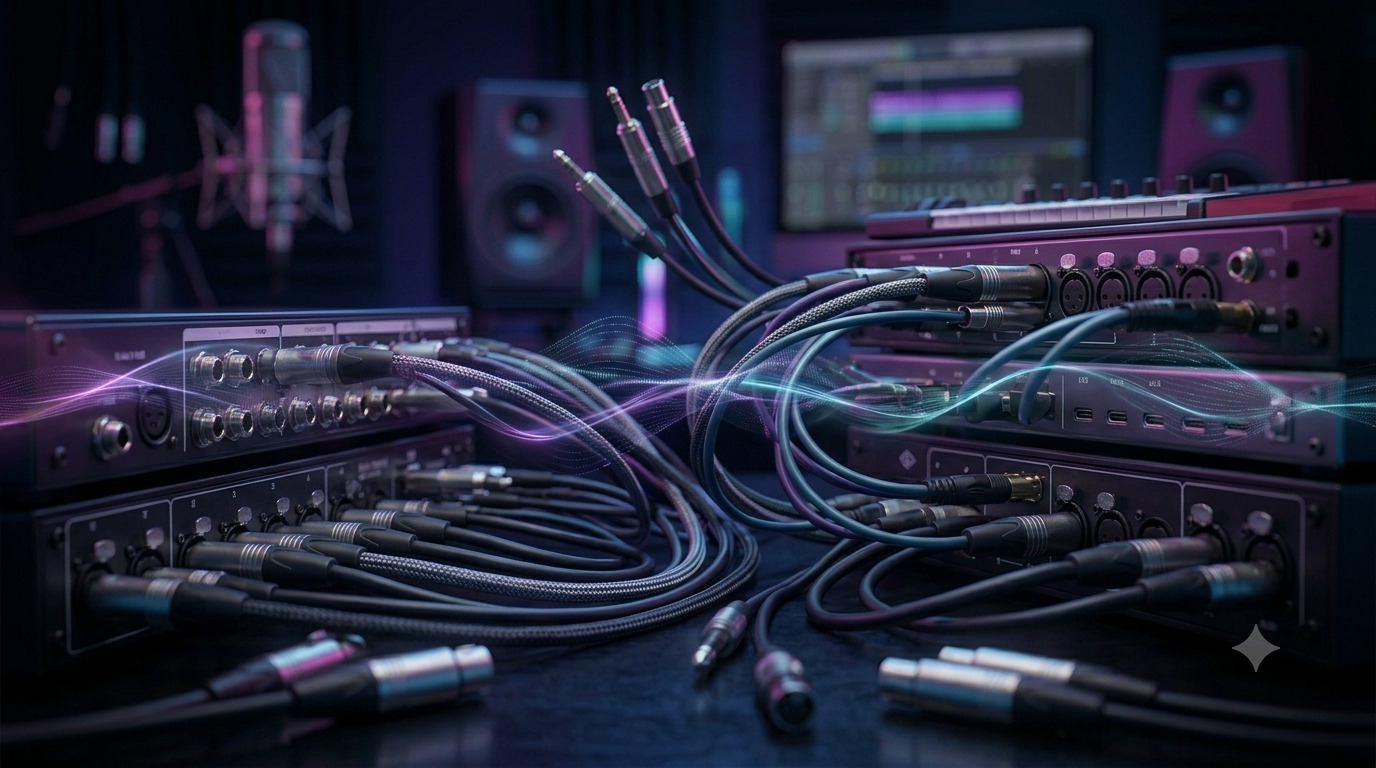
The Voltage Highway: Why Cheap Cables Are Ruining Your Mix
In the world of audio production, people love to spend thousands of dollars on premium microphones and expensive software, only to connect them with a $5 cable they found in a bargain bin. This is the ultimate bottleneck. Your studio gear communicates through electrical voltage, and if the highway carrying that voltage is poorly built, your sound will suffer.
The biggest enemy of a clean studio signal is electromagnetic interference (EMI). Every power outlet, computer monitor, and Wi-Fi router radiates invisible noise into the air. Cheap cables act like antennas, sucking in this garbage and introducing a constant background hiss or hum into your recordings.
Balanced vs. Unbalanced Signals
To protect your audio, you need to understand the difference between the two main types of cables:
- Unbalanced Cables (e.g., TS Instrument Cables, RCA): These use only two wires inside—one for the audio signal and one for the ground. They have no built-in noise defense, which is why standard guitar cables start buzzing heavily if they are longer than a few meters.
- Balanced Cables (e.g., XLR, TRS Jacks): These are the studio standard. They contain three wires: a ground, a “hot” positive signal, and a “cold” negative signal that carries an exact copy of the audio, but with its phase inverted by 180 degrees.
When the balanced signal reaches your audio interface or monitor, the device flips the negative signal back into phase. Through a phenomenon called phase cancellation, any noise collected along the cable highway is instantly obliterated, leaving you with a crystal-clear, whisper-quiet signal.