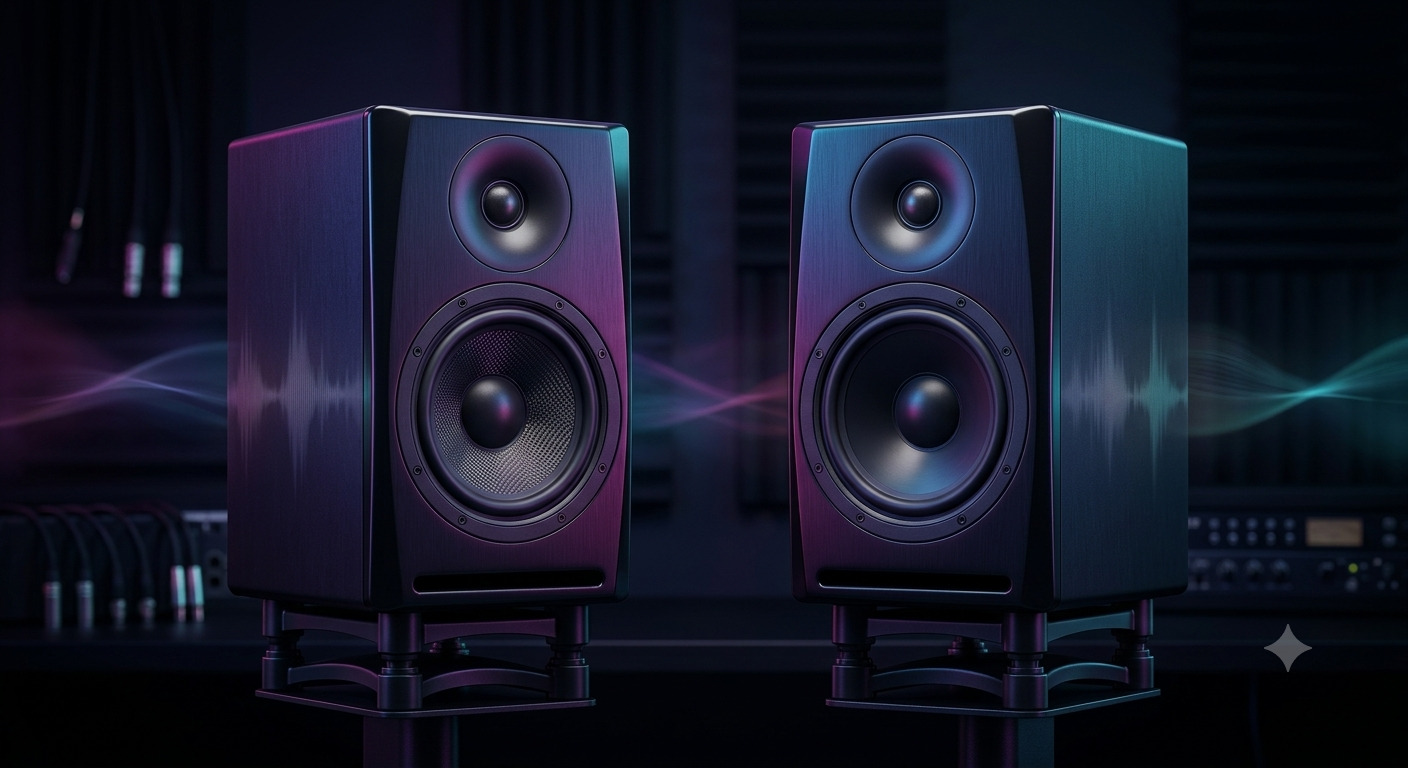
The Brutal Truth: How to Choose Studio Monitors That Don’t Lie
When you buy standard commercial speakers or hi-fi systems, you are buying a lie. Hi-fi speakers are engineered to flatter your ego—they boost the low-end to make it punchy and scoop the mids to make everything sound smooth and polished. That is completely fine for casual listening, but it is a death sentence for a music producer.
If your speakers are lying to you, your mix will sound terrible everywhere else. If your speakers artificially boost the bass, you will automatically turn the bass down in your DAW. The result? When your track plays in a car or a club, the bass will be completely missing.
What to Look For: Frequency Response and Placement
To fix this, you need studio monitors. A true studio monitor aims for a flat (linear) frequency response. It does not add artificial bass or sweeten the high frequencies; it shows you the brutal, unedited truth of your audio file.
However, even the best monitors can be ruined by bad room placement. Sound waves bounce off your walls, ceilings, and desk, creating acoustic reflections that distort what you hear. To get the most accurate listening environment:
- Set up your monitors and your listening position in a perfect equilateral triangle.
- Point the tweeters (the smaller, upper speakers) directly at your ears.
- Keep them away from corners, which cause artificial, muddy bass build-up.